

If your child has been diagnosed with an egg allergy, you may have been told about something called the egg ladder. While the name can sound a little daunting, it’s actually a carefully planned way of helping many children gradually tolerate egg as they outgrow their allergy.
The good news is that most children with an egg allergy will eventually outgrow it, and introducing egg in the right way may even help speed up this process. However, it’s important that an egg ladder is only started when your allergy doctor, paediatrician or dietitian has confirmed that it is appropriate for your child.
What is the Egg Ladder?
The egg ladder is a step-by-step method of introducing foods containing increasing amounts of egg, starting with egg that has been cooked for a long time at a high temperature and gradually progressing towards lightly cooked and eventually raw egg.
Cooking changes the structure of egg proteins. The longer and hotter egg is cooked—especially when mixed into foods such as cakes—the less likely it is to trigger an allergic reaction. As tolerance develops, many children are then able to move on to foods containing less cooked egg.
This gradual approach is widely used in paediatric allergy clinics throughout the UK. Research suggests that regularly eating baked egg, when it is safe to do so, may help children develop tolerance sooner than avoiding egg completely
Why might my child be advised to use an Egg Ladder?
Your healthcare professional may recommend an egg ladder if your child has:
- Mild to moderate egg allergy.
- Experienced hives or swelling after eating egg.
- Delayed eczema or gastrointestinal symptoms related to egg.
- Been assessed as suitable to try egg safely at home.
The aim is not simply to test whether your child can eat egg. Regular exposure to tolerated forms of egg may help the immune system become less sensitive over time, while also allowing your child’s diet to become more varied.
Who should NOT use an Egg Ladder at home?
The egg ladder is not suitable for every child.
It should not be started without medical advice if your child has previously experienced:
- Breathing difficulties after eating egg.
- Wheezing.
- Floppiness or collapse.
- Anaphylaxis.
- Poorly controlled asthma.
These children may need to introduce egg under medical supervision in hospital instead.
When is the best time to start?
Choose a day when:
- Your child is completely well.
- Their asthma or eczema is well controlled.
- They haven’t recently needed antihistamines (unless advised otherwise by your allergy team).
- You’ll be at home for several hours afterwards.
- You have children’s antihistamine available if recommended by your healthcare professional.
Avoid introducing new foods at the same time, as this makes it much easier to identify the cause if a reaction occurs.
How does the Egg Ladder work?
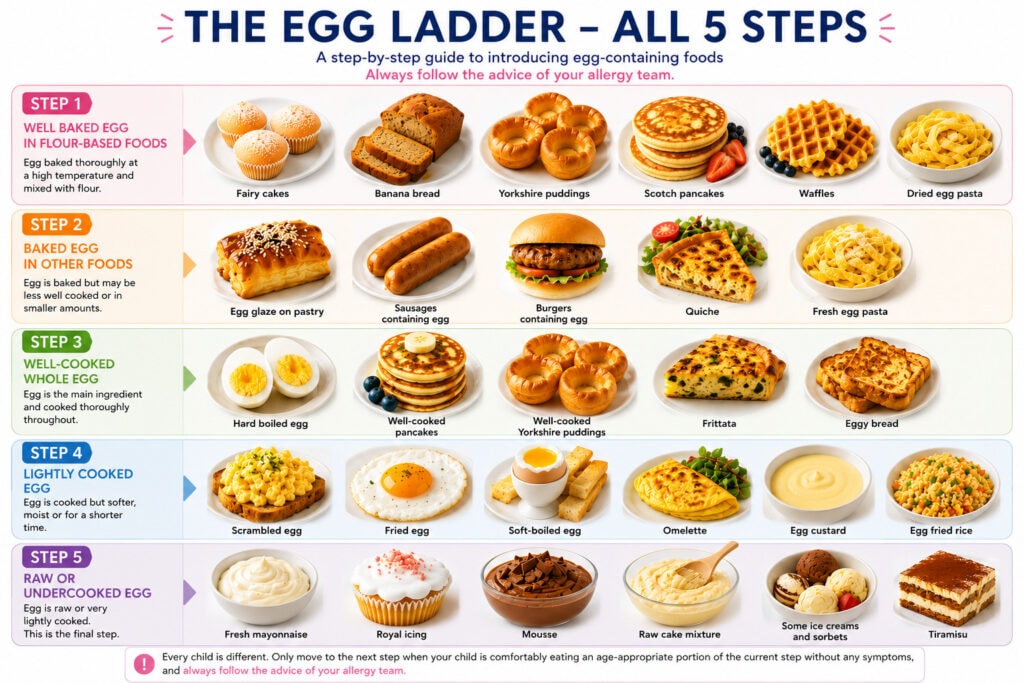
The ladder begins with foods where egg has been baked thoroughly within other ingredients before progressing to less cooked egg.
Step 1 – Well baked egg in a flour-based food
Examples include:
- Fairy cakes
- Banana bread
- Yorkshire puddings
- Scotch pancakes
- Waffles
- Dried egg pasta
- Some meatballs containing egg
These foods contain egg that has been cooked for a long time at a high temperature, making it the easiest form for many children to tolerate.
Step 2 – Baked egg in other foods
Once Step 1 is well tolerated, children may move on to foods such as:
- Egg glaze on pastry
- Sausages or burgers containing egg
- Quorn products containing egg
- Fresh egg pasta
Step 3 – Well-cooked whole egg
This stage introduces egg where it is the main ingredient, including:
- Hard-boiled egg
- Well-cooked homemade pancakes
- Well-cooked Yorkshire puddings
Step 4 – Lightly cooked egg
As tolerance improves, children may progress to:
- Scrambled egg
- Fried egg
- Soft-boiled egg
- Omelette
- Egg custard
- Egg fried rice
Step 5 – Raw or undercooked egg
The final stage includes foods containing raw or minimally cooked egg, such as:
- Fresh mayonnaise
- Royal icing
- Homemade mousse
- Raw cake mixture
- Some ice creams and sorbets
This stage should only be attempted when advised by your allergy team.
How quickly should you move through the ladder?
Every child progresses differently.
The North West Paediatric Allergy Network recommends starting with a tiny amount—around the size of a grain of rice—and gradually increasing the amount over time until a normal portion is tolerated. Once a stage is tolerated, the food should be offered regularly (at least three times each week) before progressing to the next step.
Some children may move through the ladder quite quickly, while others remain at one stage for months. There is no prize for finishing first—the goal is steady, safe progress.
What if my child reacts?
If your child develops mild symptoms such as:
- Hives
- Mild swelling
- Itching
- Tummy discomfort
stop increasing the amount and follow the advice in your allergy management plan. If advised by your healthcare professional, give an antihistamine.
Once symptoms have settled, many children can continue eating the last amount they tolerated rather than avoiding egg completely. Your allergy team can then advise when to try increasing again.
However, seek urgent medical help immediately if your child develops:
- Difficulty breathing
- Wheezing
- Persistent coughing
- Swelling affecting the airway
- Floppiness
- Collapse
- Signs of anaphylaxis
Call 999 immediately if you suspect a severe allergic reaction.
Tips for success
✔ Be patient—progress can take months rather than weeks.
✔ Offer tolerated egg regularly to help maintain tolerance.
✔ Never force your child to eat egg-containing foods.
✔ Keep a simple diary of foods eaten and any symptoms.
✔ Continue reading food labels carefully, especially if your child has other allergies.
✔ Stay in touch with your allergy team if you’re unsure about the next step.
Will my child always have an egg allergy?
Fortunately, the outlook is very positive.
Around 70–80% of children outgrow an egg allergy during childhood, although the age at which this happens varies. Many children tolerate baked egg long before they can eat lightly cooked or raw egg.
Final thoughts
An egg allergy diagnosis can feel overwhelming, but for many families the egg ladder offers a safe, structured route towards expanding their child’s diet and, ultimately, helping them outgrow their allergy.
Remember that every child is different. Always follow the advice of your allergy specialist, paediatrician or dietitian, and never compare your child’s progress with someone else’s.
If you’re feeling unsure about introducing egg, or you’d like personalised guidance on managing food allergies during weaning or beyond, I’d be delighted to help. As a Registered Nutritionist with over 20 years of experience supporting families, I offer one-to-one consultations tailored to your child’s individual needs. Check out my website for more information about how we can work together.
